

Employee Competency Management
An enterprise's competitive advantage lies in effective human resource management and application. The Employee Competency Management Module within the HR system defines employee responsibilities and core competencies—including multi-dimensional competencies and capability assessment and analysis—then connects these results to training and development, performance evaluation, recruitment, hiring, and reward and discipline management. This enables employee capabilities and job roles to align closely with the company's vision, goals, and strategy, helping employees grow while strengthening the organization's core competitiveness.
How can the Employee Competency Management Module enhance enterprise competitiveness?
Defining Competencies – Job Descriptions
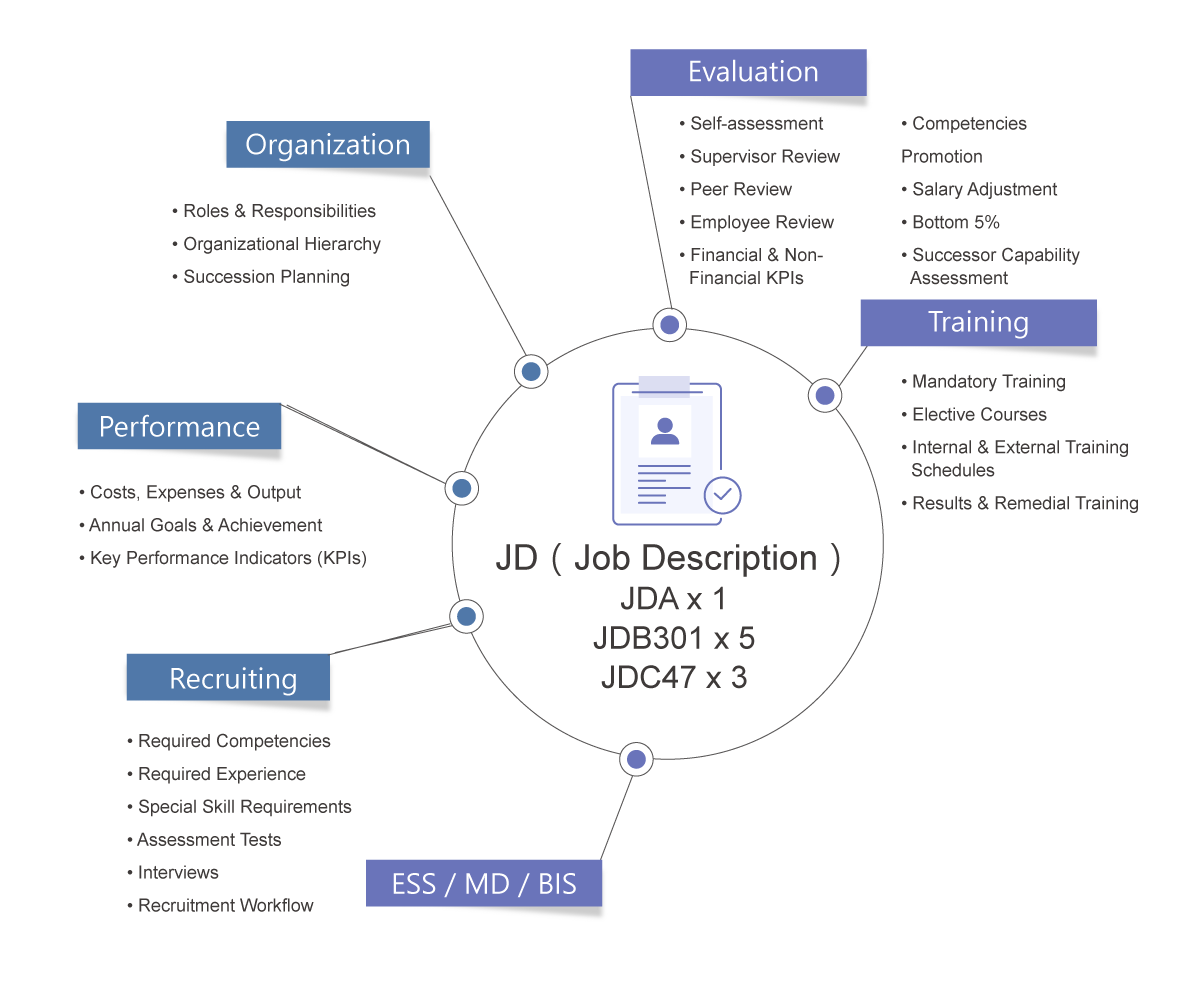
Job descriptions form the foundation of human resource management. Selection criteria for recruitment, performance evaluation benchmarks, salary structure planning, and employee training programs are all built upon well-defined job descriptions. These descriptions typically include organizational roles and responsibilities, personnel costs and performance, recruitment processes, training programs, and promotion and evaluation criteria—helping enterprises develop a coherent HR strategy and centrally manage employee competencies.
Competency Matrix
Based on different employee levels, corresponding role and competency matrices are created to clearly present the core and managerial competencies required for each position.
| Cat. | Competency | Staff | Supvr. | GM | CxO |
|---|---|---|---|---|---|
| Core Competencies | Innovation | ||||
| Challenge Excellence | |||||
| Building Partnership | |||||
| Planning and Executing | |||||
| Management Competencies | Developing Organizational Talents | ||||
| Building Trust | |||||
| Empowerment Leadership | |||||
| Valuing Diversity | |||||
| Strategic Leadership | |||||
| Visionary Leadership | |||||
| Entrepreneurial Insight |
Competency Dictionary
The primary purpose of a competency dictionary is to categorize competency-related behavioral indicators, enabling HR practitioners to define competencies for different roles. The defined competency levels can be linked with employee training programs to effectively track training outcomes and management effectiveness.
Employee Competency Assessment
Employee competency assessment compares the required competency levels defined in job descriptions with actual assessment results. If an employee’s professional knowledge or skills fall below the required level, it indicates the need for competency development and improvement.