

The Preferred Human Resource System for Taiwan's Top 100 Enterprises
Research shows that enterprises that adopt digital transformation earlier achieve higher profitability. For multinational groups with large, complex organizations, implementing comprehensive digital HR tools is essential to improve operational efficiency.
HCP adapts to frequently changing labor regulations through multi-organizational structures and flexible parameter design, enabling HR teams to manage large-scale payroll and flexible scheduling. Built on enterprise-grade Oracle database encryption, HCP is a highly recommended choice among Taiwan's top 100 enterprises.
Seven Key Features That HCP Improves on HR Management

Group-Based Organizational Structure
Centralized management of HR assets across subsidiaries or sites for effective resource integration

Local Insurance and Tax Compliance
Supports local tax and insurance systems in Taiwan, China, Hong Kong, Vietnam, Indonesia, and Thailand, with updates aligned to tax regulations

Fast Payroll / Flexible Scheduling
Handles high-volume payroll and multiple shift configurations to meet complex manufacturing needs

Granular HR Access Control
Defines role-based data access by region, department, job level, and employee type
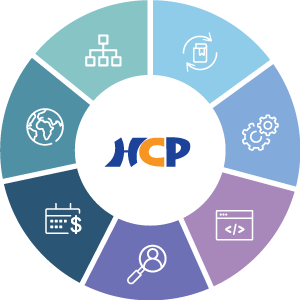

Regulation-Driven Updates
System functions updated in real time to reflect changes in income tax and labor regulations

Regulation-Driven Updates
System functions updated in real time to reflect changes in income tax and labor regulations

Source Code Technology Transfer
Delivers system source code with full technology transfer and HR infrastructure planning services
Implementation Benefits

Before Implementation
|

After Implementation
|
|---|---|
| Manual recalculation required for labor law and tax updates, time-consuming and labor-intensive. | HCP updates system versions in line with labor law changes, allowing HR to flexibly set overtime rates, recognized hours, and multiple annual leave and carryover rules. |
| Payroll processing for hundreds or thousands of employees takes an entire day. | Supports high-volume payroll with automatic import of attendance and overtime data for higher accuracy. |
| HR must assist managers and employees with HR inquiries, increasing communication overhead and delaying core tasks. | Employees can access HR data, payroll, and tax statements anytime; managers can monitor attendance in real time. |
| Complex scheduling in high-tech or manufacturing relies on manual work, which is time-consuming and error-prone. | Supports multiple shift patterns (e.g., 2-on-2-off, 3-on-1-off, 4-on-2-off) and batch shift adjustments for manufacturing needs. |
| As enterprises grow, HR management becomes complex and employee data leakage risks increase. | Role-based access controls by job function and responsibility reduce data leakage risks, even for multinational enterprises. |
| Group HR data cannot be consolidated, requiring repeated file transfers, communication, and data entry. | Overseas subsidiary data automatically integrates with headquarters HR systems, enabling group-wide visibility on a single platform. |
| Overseas system incidents cannot be resolved promptly, disrupting HR operations. | HCP maintains service locations in Mainland China to provide rapid support for overseas subsidiaries. |