

The Preferred HRM System for Large Enterprises
— HCP Human Resource Management
HRM refers to “Human Resource Management” and includes department organization, personnel administration, shift scheduling, attendance management, local insurance, payroll management, and more, helping enterprises manage all HR-related operations. HRD (Human Resources Development) focuses on employee competency assessment, training planning, performance evaluation and tracking, and recruitment process management, enabling organizations to strengthen talent development and enhance overall performance.
As large enterprises expand, HR operations become increasingly complex due to multiple locations, diverse shift patterns, and stringent regulatory requirements. HCP (Human Capital Planner) is designed specifically for large enterprises, capable of processing over 4 million attendance records per day. By integrating HR, payroll, attendance, performance management, and recruitment into a single platform, HCP provides a one-stop solution that fully supports the complex HR needs of group enterprises, high-tech industries, and manufacturing sectors. It frees HR teams from time-consuming manual work, allowing them to focus on strategic planning and talent development—making HCP a powerful strategic partner for enterprise HR.
HCP HRM Core Functions


HCP HRD Core Functions


HCP Standalone Modules
Enterprises can select standalone add-on services based on their needs to enhance HR workflows, improve employee experience, and optimize HR operations with complete data access anytime, anywhere.


Three Key Advantages of the HCP HRM System
Low customization, covering over 90% of HR management processes
Manufacturing enterprise customer: “The less customization, the more stable the system. HCP’s built-in best-practice workflows align with most enterprise HR policies, reducing customization while improving system stability and maintenance efficiency.”
Enterprises can leverage HRM system implementation as an opportunity to review internal HR policies and workflows through standardized functions, accelerating process adoption. In response to frequent labor regulation changes, ARES continuously enhances HCP modules based on the latest laws and user feedback. Through ARES’s R3M implementation methodology, customers can establish enterprise-grade HR processes comparable to global corporations—without additional consulting fees.
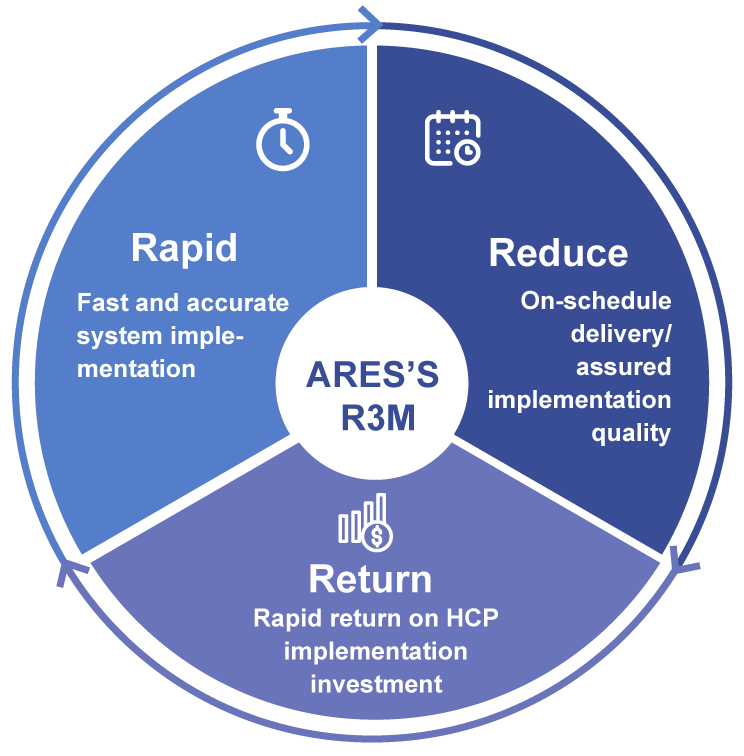
Rapidly Establish Standardized HR Processes
For large enterprises with over a hundred employees and complex organizational structures, rapidly implementing an HRM system and formalizing HR processes not only improves operational efficiency, but is also critical to organizational stability and regulatory compliance.
The HCP HRM system consolidates HR implementation experience from global enterprises into 62 practical HR management SOPs, covering onboarding, probation evaluation, personnel changes, and offboarding processes that enterprises can apply directly to enhance HR process maturity. In addition, HCP adopts standardized implementation and training mechanisms to shorten go-live timelines and reduce manpower requirements. With professional support from HCP consultants, enterprises can diagnose and optimize existing workflows to build more efficient operating processes.
-
1 Project PlanningDedicated consultant, timeline planning, kickoff meeting
-
2 System Environment SetupHardware and HCP installation
-
3 Requirement Simulation & ReviewQuestionnaires, pain-point analysis, HR training
-
4 System Architecture ReviewWorkflow diagrams, permission lists, documentation
-
5 Test Environment SetupHCP parameter and ESS/MSS permission setup
-
6 Alternative SolutionGap report confirmation and solution planning
-
7 Data MigrationData preparation and legacy system conversion
-
8 Integration TestingIssue resolution, review meetings, payroll validation
-
9 User TrainingAPI transfer, alert setup, user training
-
10 Parallel OperationParameter setup, issue support, payroll verification
-
11 Go-LiveGo-Live support, payroll assistance, acceptance review
Comprehensive Customer Support Mechanism
-
HR System Support Website and Service Platform
Provides a support website and customer service platform (Mantis), enabling real-time tracking of system issues and allowing users to submit inquiries directly, accelerating issue resolution in a convenient and efficient manner.
-
Daily Support Inquiry
Provides 4×8 phone support for system issue resolution, with responses within 4 business hours and solutions provided within 8 hours.
-
Remote Diagnostic Service
Provides remote diagnostics to quickly identify root causes; in case of HR system failures, on-site repair services can be arranged within 8 business hours when necessary.
-
Regular System Review Visits
Annual system review visits with satisfaction surveys, on-site issue assessments, and solution recommendations.
-
Regular Training Programs
Regular training sessions for MIS and HR personnel to enhance system operation and application proficiency.
-
Additional System Services
- Data backup and recovery services
- Monthly product updates and upgrades.
- One annual backend system performance optimization service.
- One free alert and one report provided annually.
- Flexible parameter settings allow easy self-adjustment when company policies change.
- In payroll emergencies, ARES provides immediate support to resolve system issues.
HRM Target Industries and Best Practices
Connects multi-company group structures with cross-border HR access control
- Overseas employee data automatically integrated with headquarters HR systems
- Role-based access permissions by region, department, job level, and employee type
- Supports multi-company management with one-click group subsidiary HR reports
- HR can adjust report fields as needed without additional customization costs due to regulatory or policy changes


Complex shift management with flexible annual leave calculation
- Supports complex scheduling and leave planning, shift rotations, anniversary/calendar systems, shift allowance calculation, and flexible/rotational/special leave management
- Flexible configuration of overtime rates and recognized hours
- Configurable multiple annual leave schemes (anniversary/calendar-based) with carryover rules
- Annual leave automatically granted based on hire date, with seniority adjusted for unpaid leave
Remote clock-in, fast payroll processing, regulatory updates
- Remote work online clock-in
- Automatic import of attendance and overtime data
- Payroll data automatically transferred to ERP general ledger
- System synchronized with government regulation updates
- Employees submit leave/overtime requests online with mobile approval by supervisors
HRM System Implementation FAQ
Q1: What is the difference between HRM and HRD systems?
HRM (Human Resource Management) systems focus on daily operations such as personnel administration, payroll, and attendance, while HRD (Human Resource Development) systems emphasize employee training, career development, and performance management. Together, they complement each other to enhance overall HR effectiveness.
Q2: What are the differences between HRM, HRIS, and HCM systems?
HRM focuses on daily HR operations such as personnel, payroll, attendance, and performance; HRIS is primarily used for managing core HR data; HCM emphasizes human capital strategy and talent development. The HCP HRM system combines robust data management with localized regulatory support, balancing daily operations and long-term planning.
Q3: What are the implementation steps for HCP HRM?
Typical enterprise implementations include requirement analysis, system configuration, data migration, user training, and system acceptance. ARES assigns dedicated consultants to guide the process and ensure a smooth go-live.
Q4: Can the HCP HRM system be used on mobile devices?
The system supports an RWD web interface across mobile phones, tablets, and PCs, allowing employees to access payslips, submit leave requests, and view attendance data anytime, anywhere.
Q5: How does the HRM system integrate with existing ERP or financial systems?
HCP provides standard APIs and file import/export functions to integrate with existing ERP, finance, and IAM systems, ensuring real-time data synchronization.
Q6: How do multinational enterprises handle regional regulatory differences?
The HCP HRM system supports regulations across Southeast Asia (Vietnam, Thailand, Malaysia), Mainland China, and Taiwan, enabling HR teams to flexibly adjust tax and social insurance rules to meet local compliance requirements.