+886-3-571-6622 ext. 777
MES vs. ERP — Key Insights for Manufacturing Digital Transformation
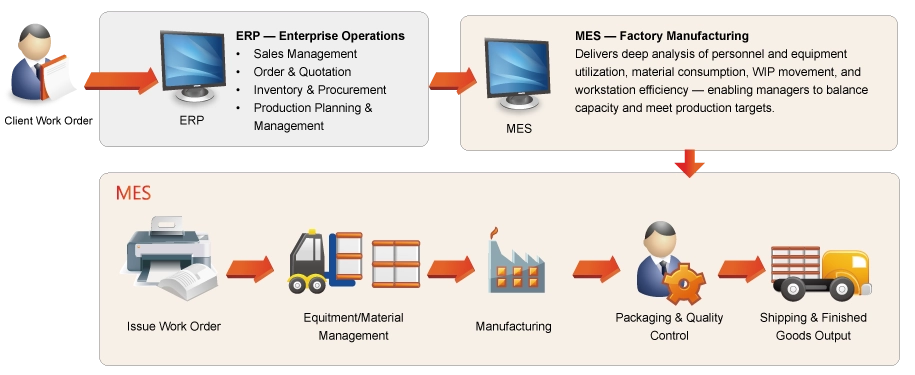
MES delivers deep analysis of personnel and equipment utilization, material consumption, WIP movement across stations, and workstation efficiency — empowering managers to make informed workforce decisions and balance capacity to meet production targets.
ERP covers enterprise-level operations — procurement, finance, sales, and production order management. But on the factory floor, beyond basic material consumption, ERP cannot handle work order dispatching, production traceability, SPC quality analysis, equipment utilization, or predictive maintenance. That is where only MES delivers.
Only by integrating MES and ERP — connecting information flows across every stage of the product lifecycle — can enterprises achieve a true 1+1>2 synergy and accelerate their journey toward smart manufacturing and digital transformation.
MES vs. ERP Comparison
| Category | MES | ERP |
|---|---|---|
| Scope | Real-time production line control & management | Enterprise-wide operations management |
| Focus | Shop floor resources (equipment, processes, materials) | Business resources (people, finance, assets) |
| Coverage | Production and process execution management | Value chain and supply chain integration |
| Data Source | Automatic or semi-automatic shop floor capture | Manual input from each department |
| Timeframe | Fine-grained — by day, shift, or hour | Broad — by year, quarter, month, week, or day |
| Benefits | Production scheduling, anomaly handling, quality control | Cost control and resource allocation |
MES and ERP Integration
ERP focuses on planning while MES focuses on execution. Due to their different natures, they have traditionally operated as separate systems, with most enterprises centering their resource management around finance and accounting-driven ERP.
No Longer Separate — MES and ERP Working Together
As business and production management thinking has evolved, ERP's manufacturing modules alone can no longer handle real-time shop floor management. This gap gave rise to MES — a dedicated system built specifically for factory operations.
MES serves as the bridge between shop floor equipment and enterprise operations. By collecting real-time manufacturing data to support detailed process management, and feeding that data back into ERP, MES enables more efficient and accurate resource allocation — closing the gap between factory operations and business management on the path to smart manufacturing.
ARES ciMes & ERP Integration
Via ciMes's ERP data transfer interface, information such as work orders, BOMs, and material issuance is imported in real time, while completion data is fed back to ERP — fully connecting both systems and significantly reducing production lead time and putaway operations.
ERP & MES Integration List:
| Item Master File (ERP → ciMes) | ERP item master data periodically synced to ciMes. |
| Work Order Master File (ERP → ciMes) | Transferred to ciMes upon work order confirmation in ERP. |
| Work Order BOM (ERP → ciMes) | BOM version applied at time of material issuance transferred to ciMes. |
| Work Order Material Issuance (ERP → ciMes) | Full kit issuance details transferred to ciMes to create material lots. |
| Material Return (ERP → ciMes) | Production line returns transferred from ciMes back to ERP. |
| Finished Goods Putaway (ERP → ciMes) | Completed goods data transferred to ERP finished goods warehouse. |
| Defective Goods Putaway (ERP → ciMes) | Scrap from production transferred in real time to ERP defectives warehouse. |
| Labor Hours Transfer (ERP → ciMes) | Actual production hours transferred to ERP for cost calculation. |
| WIP Station Pass Data (ERP → ciMes) | Production station pass data transferred to ERP. |