+886-3-571-6622 ext. 777
What is AI Smart Manufacturing?

AI smart manufacturing integrates artificial intelligence, IoT, and machine learning into production processes to improve efficiency, quality, and flexibility. It enables data-driven decision-making across automation, predictive maintenance, quality monitoring, supply chain optimization, and real-time production scheduling — a core pillar of Industry 4.0.
Why Must Factories Upgrade to AI Smart Manufacturing?
As IoT, 5G, sensors, big data, and cloud computing mature, manufacturers face these key challenges:
- Complex processes and diverse product types make manual recording slow and error-prone
- Reliance on manual judgment leads to inconsistent SOP execution and high training costs
- Rapidly shifting quality standards and market demands exceed the capacity of manual scheduling and inspection
- Fragmented data, time-consuming report consolidation, and manual analysis slow down decision-making
- Traditional MES focuses on data collection and process management but lacks intelligent judgment and early warning capabilities
Only by combining AI with MES can factories achieve true real-time monitoring, automated judgment, and intelligent decision support — building a smart factory ready for Industry 4.0.
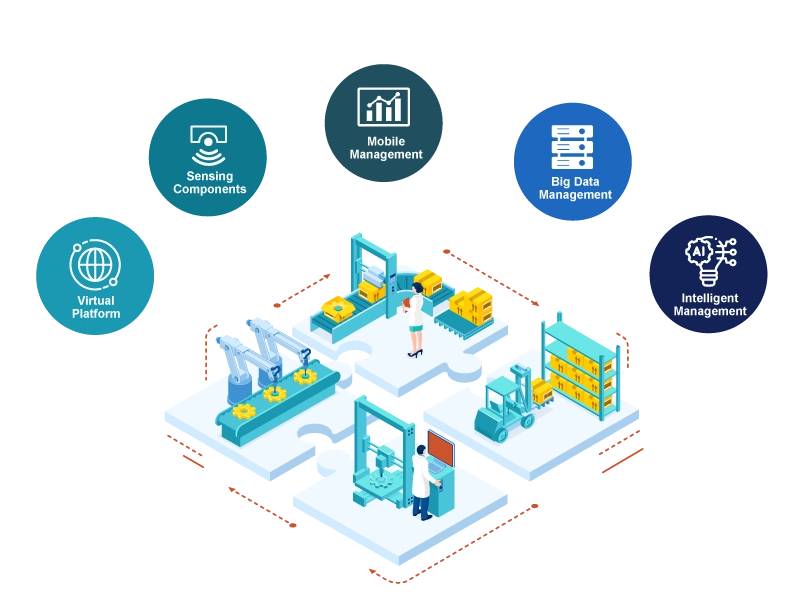
3 Stages of Smart Manufacturing Implementation:
Stage 1: Implement Automation Equipment
Automation is the foundation of smart manufacturing. By introducing automated equipment, factories can replace repetitive and high-risk manual tasks, improve production efficiency, standardize products, and enable human-machine collaborative management. Given the complexity and cost involved, companies should assess equipment capability, automation scale, and expected ROI based on their own conditions.
Stage 2: Build Machine Connectivity (IoT)
Automation alone is not smart manufacturing — it must be combined with IoT, big data, and AI. Connecting factory equipment via IoT enables real-time monitoring of machines, production parameters, processing status, and measurement values throughout the manufacturing process.
Stage 3: Achieve Intelligent Production
Aggregate IIoT data into MES for analysis and action. Real-time production tracking, equipment parameter collection and control, process feedback, anomaly alerts, and predictive maintenance work together to improve equipment utilization and product yield — achieving truly intelligent factory production.
Traditional vs. Smart Manufacturing Comparison
| Category | Traditional Manufacturing | Smart Manufacturing (AI+MES) |
|---|---|---|
| Production Data | Manual recording via paper or Excel — prone to errors and omissions | Real-time automatic collection with systematic management |
| Quality Control | Primarily sampling-based inspection, difficult to trace | Comprehensive AI inspection, auto-flagging, and full traceability |
| Anomaly Handling | Discovered after the fact → reactive response | Real-time detection → early warning → rapid response |
| Equipment Management | Scheduled manual inspections | AI predictive maintenance and utilization monitoring |
| Reporting & Decision Making | Manual consolidation, time-consuming | Auto-generated reports with real-time decision support |
| Overall Efficiency | Limited by human capacity and experience | Stable, efficient, measurable, and continuously optimizable |
3 Key Applications of AI Smart Manufacturing
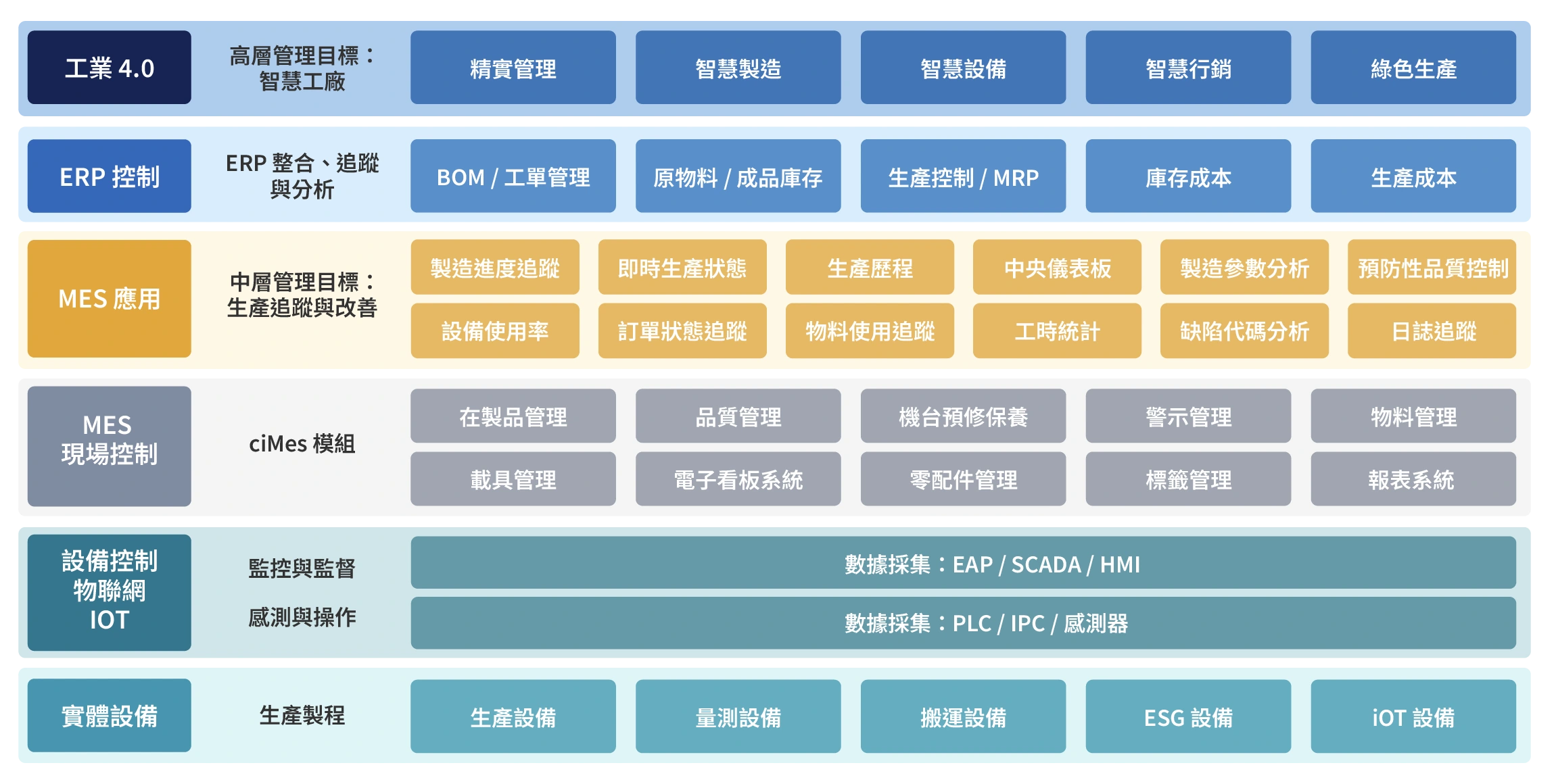
MES plays a critical role as foundational infrastructure for factories aiming for smart manufacturing. A robust foundation allows for better adaptation to future changes and challenges. Ares ciMes combines AI technology to create a real-time, data-visualized factory management platform, automating, digitizing, and intellectualizing the manufacturing process. This helps enterprises build smart factories and achieve AI smart manufacturing!
-
1. AI Vision & Motion Recognition — Error-Proofing & Operator
Using cameras and AI models, the system automatically identifies operators, workstations, actions, and assembly positions — ensuring every SOP step is followed and eliminating human error. -
2. Automated Process Monitoring + Real-Time Alerts
IoT sensors collect machine parameters (temperature, pressure, torque, speed, etc.), which AI continuously compares against standard values — triggering instant alerts and logging any deviation to ensure stable processing quality.+ -
3. AI Automated Quality Inspection + Full Traceability
Image recognition technology automatically detects and classifies product defects, replacing manual visual inspection — while MES maintains a complete production history for downstream analysis and quality improvement.
9 Major Benefits of ciMes AI for Factories
With the rise of new technologies, building a smart factory is no longer difficult. Ares ciMes Manufacturing Execution System helps enterprises gain real-time insights into equipment status, production progress, and quality data, significantly reducing error rates, shortening response times to anomalies, improving decision-making efficiency, and achieving highly flexible intelligent production.
| Benefit | Key Functions | Outcomes | |
|---|---|---|---|
| 1 | Reduce Error Rates | AI auto-identification of operators and workstations, SOP error-proofing | Fewer wrong assemblies, missed steps, and human errors |
| 2 | Faster Anomaly Response | Real-time process data collection, AI deviation detection, auto-alerts | Instant notification, reduced line stoppages and rework |
| 3 | Automated Production Lines | AI automated quality inspection, defect flagging and classification | Improved quality, lower defect rates and customer complaint risk |
| 4 | Save Reporting Time | AI assistant, auto-generated reports, real-time electronic kanban | Managers access production and quality data instantly |
| 5 | Improved Equipment Utilization & Maintenance | AI predictive maintenance alerts, equipment status monitoring | Fewer breakdowns, unplanned downtime, and maintenance costs |
| 6 | Production Transparency & Traceability | Production history, material lot traceability, work order tracking | Complete traceability chain for better supply chain management and compliance |
| 7 | Real-Time Production Visibility | AI assistant with natural language query for production progress, quality, and historical data | Instant production insights without navigating multiple systems |
| 8 | Faster Anomaly Root Cause Analysis | AI auto-integration of product history, process records, and anomaly events | Rapid root cause identification for faster resolution and quality improvement |
| 9 | Better Management Decision-Making | AI auto-generated kanban with multiple visualization chart types | Management gains instant factory visibility for significantly faster decisions |
ARES ciMes — The Optimal Solution for Smart Manufacturing
As Industry 4.0 accelerates, smart factory automation has become the new standard across manufacturing, agriculture, and healthcare. According to Research Nester , the smart manufacturing market surpassed USD 300 billion in 2025 and is projected to reach USD 1 trillion by 2035. MES will be the decisive cornerstone of every smart factory and Industry 4.0 journey.

Smart Manufacturing Case Studies
- Automation: TXC Technology / Ho Song Enterprise / Grand Biotechnology
- Smart Production: Gogoro / Everest Textile
- Process Visualization: Jentech / Fortune Electric / Hodaka Technology
- Smart Supply Chain: Coil Technology / Chimei Corp. / Kinsus
- Smart Factory Floor: ITRI
Smart Manufacturing FAQ
Q1:What is the main difference between smart manufacturing and traditional manufacturing?
Smart manufacturing integrates MES and AI to provide real-time visibility into production status, quality, and equipment — enabling data-driven decisions. Traditional manufacturing relies on manual recording and experience, resulting in limited transparency and no traceability.
Q2:Is factory automation the same as smart manufacturing?
No. Factory automation focuses on replacing manual labor with machinery, but without integration across supply chain, equipment, and production data, true intelligence cannot be achieved. The core of smart manufacturing is data connectivity, process optimization, and real-time decision-making — not just equipment automation.
Q3:What are the most critical success factors for implementing smart manufacturing?
Successful smart factory implementation requires executive support, user buy-in, and IT integration. Partnering with experienced MES consultants is also essential to drive organizational change and ensure effective deployment.
Q4:Should smart manufacturing be implemented all at once?
A phased approach is recommended. Smart factory implementation requires clear stage-by-stage goals and KPIs — starting with lean management and digital processes before advancing to intelligent applications. A 3 to 5 year roadmap is typically advised to progressively achieve data integration, process optimization, and smart manufacturing.